
Session Information
Date: Thursday, June 8, 2017
Session Title: Other
Session Time: 1:15pm-2:45pm
Location: Exhibit Hall C
Objective: Characterize oscillatory activity in and around the nucleus basalis of Meynert (NBM).
Background: The NBM is the major source of cholinergic innervation to the neocortex. It is a new potential target of deep brain stimulation (DBS) for cognitive sequelae in Parkinson’s disease (PD) dementia and Lewy Body dementia (1, 2). In order to effectively stimulate the NBM, more knowledge about its anatomical delineation and local neurophysiological activity is needed. PD patients with implanted globus pallidus interna (GPi) electrodes often have their most distal contact points in the vicinity of the NBM. This enables the recording of neural activity in this area.
Methods: Bipolar LFPs from adjacent DBS contact pairs (bottom to top: 0-1, 1-2, 2-3) were recorded in two patients during the replacement surgery of an implanted pulse generator. For each bipolar derivation (n=12), frequency spectra were calculated over 15-sec epochs of resting state. Stereotactic coordinates of each contact and their distance to the NBM were calculated based on CT-MRI fusion images and correlated with spectral power in different frequency bands.
Results: Normalized peak power in delta band (1-4 Hz) was significantly higher in the 0-1 contact compared to the 2-3 contact pair (p=0.02, Fig. 1). The distance of the middle of the bipolar contact pairs to the NBM correlated negatively with delta peak power (cc=-0.72, p=0.007, Fig. 2) and positively with gamma (30-100 Hz) peak power (cc=0.6, p=0.03).
[figure1] [figure2]
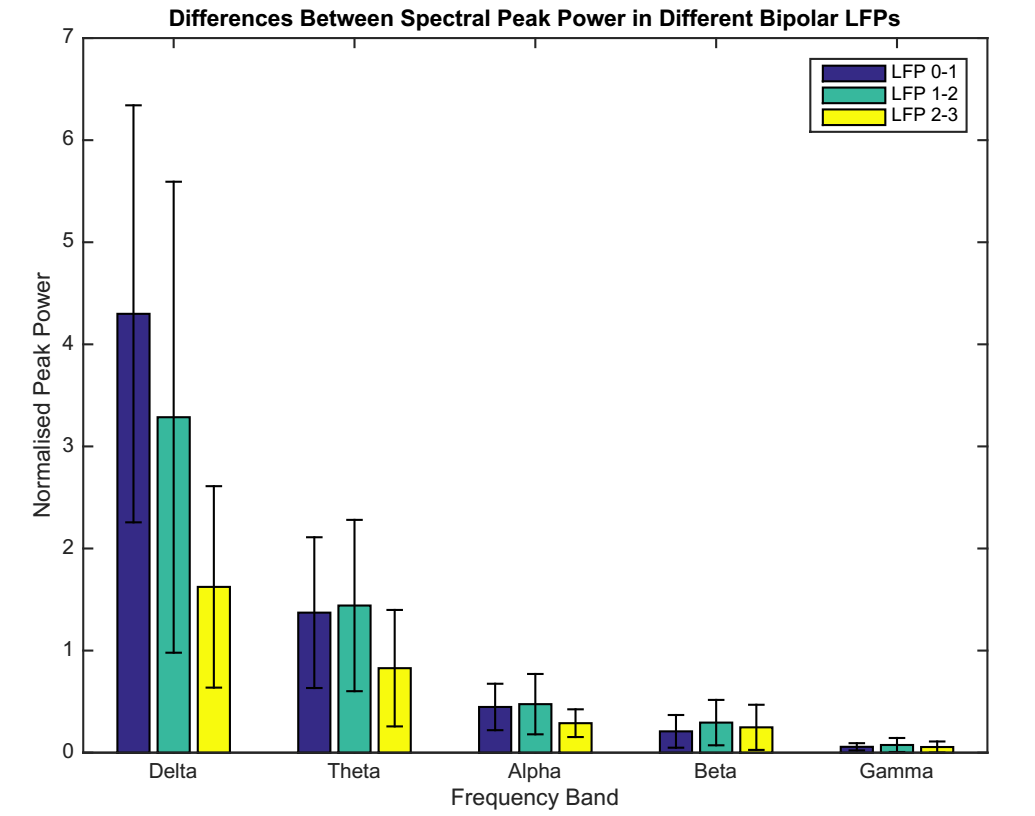
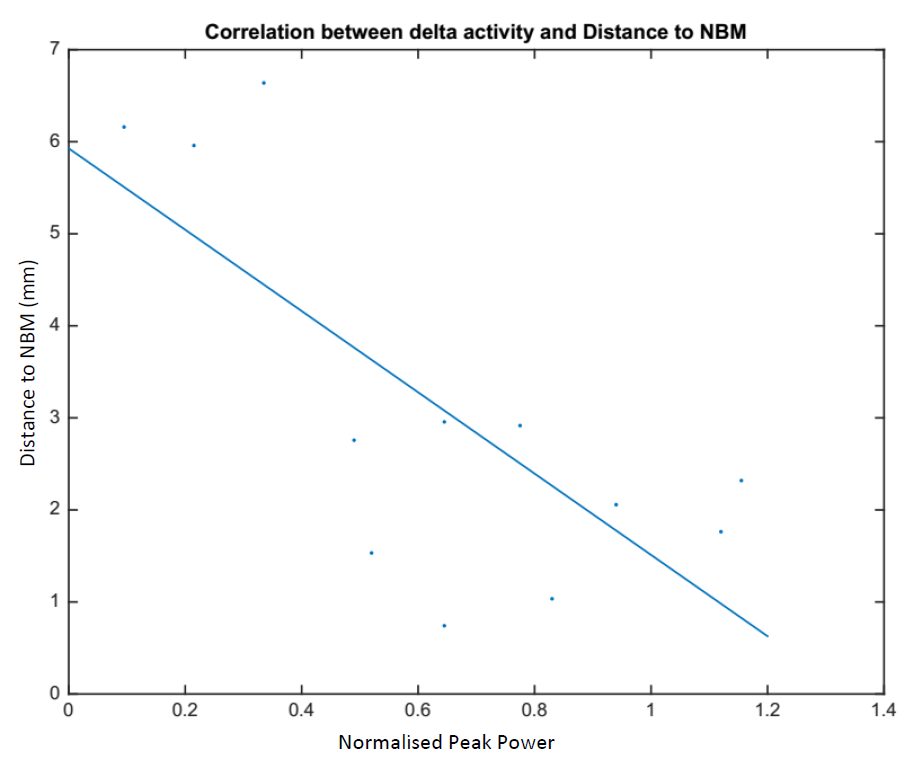
Conclusions: The increased delta and decreased gamma activity might help to functionally delineate the NBM and might be applied for directing stimulation of the NBM and the development of biomarkers for adaptive algorithms.
References: 1. Gratwicke, J., Jahanshahi, M., & Foltynie, T. (2015). Parkinson’s disease dementia: a neural networks perspective. Brain, 138(6), 1454–1476.
2. Gratwicke, J., Kahan, J., Zrinzo, L., Hariz, M., Limousin, P., Foltynie, T., & Jahanshahi, M. (2013). The nucleus basalis of Meynert: A new target for deep brain stimulation in dementia? Neuroscience & Biobehavioral Reviews, 37(10), 2676–2688.
To cite this abstract in AMA style:
M. Nazmuddin, D. Oterdoom, J. van Zijl, A. Kampman, J. van Dijk, G. Drost, T. van Laar, M. Beudel. Oscillatory Activity in the Nucleus Basalis of Meynert [abstract]. Mov Disord. 2017; 32 (suppl 2). https://www.mdsabstracts.org/abstract/oscillatory-activity-in-the-nucleus-basalis-of-meynert/. Accessed November 4, 2026.« Back to 2017 International Congress
MDS Abstracts - https://www.mdsabstracts.org/abstract/oscillatory-activity-in-the-nucleus-basalis-of-meynert/