
Category: Parkinson's Disease: Non-Motor Symptoms
Objective: We aimed to clarify the association between thyroid hormone levels and supine hypertension (SH) in patients with early Parkinson’s disease (PD).
Background: Increasing evidence suggests thyroid hormone is involved in the pathophysiology of PD. Autonomic failure at early stage affects disease prognosis. The mechanism of SH is not fully elucidated. On the other hand, thyroid hormone is known to affect cardiovascular system.
Method: One hundred twenty-nine drug-naïve patients with PD were enrolled. After an overnight fast, blood sample was collected. Blood pressure (BP) after 20min supine rest was also examined. We examined the plasma levels of thyroid-stimulating hormone (TSH), free triiodothyronine (fT4), and free thyroxine (fT3). SH was defined as a systolic BP ≥ 140 and/or diastolic BP ≥ 90 mmHg after supine rest.
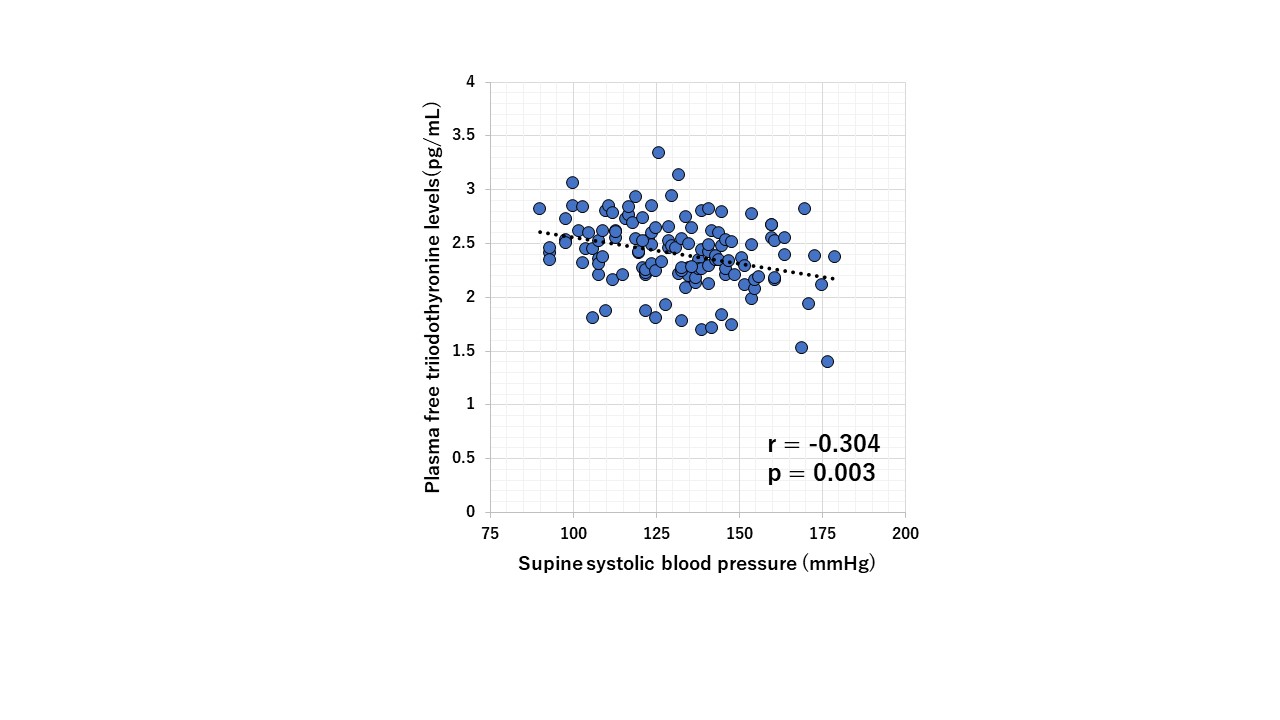
Results: Fifty-one (39.5 %) patients had SH. Supine systolic BP correlated negatively with the fT3 levels (systolic BP; r = -0.304, p = 0.003, diastolic BP; r =-0.226, p = 0.005). This correlation remained statistical significance after controlling for age, sex, disease duration, motor severity and body mass index (systolic BP; p = 0.003, diastolic BP; p = 0.005) and even after controlling for additional cardiovascular risk factors such as plasma triglyceride, low-density lipoprotein, uric acid, HbA1c levels (systolic BP; β = -0.262, SE = 5.99, p = 0.006, diastolic BP; β = -0.268, SE = 4.13, p = 0.010). Patients with SH had significantly lower fT3 levels than those without SH (p = 0.047).
Conclusion: Thyroid hormone levels, especially fT3 levels, may be associated with SH in patients with PD.
To cite this abstract in AMA style:
T. Umehara, T. Kokubu, J. Takahashi, T. Shiraishi, T. Sato, A. Onda, I. Iguchi. Association between supine hypertension and plasma free triiodothyronine in drug-naïve Parkinson’s disease [abstract]. Mov Disord. 2023; 38 (suppl 1). https://www.mdsabstracts.org/abstract/association-between-supine-hypertension-and-plasma-free-triiodothyronine-in-drug-naive-parkinsons-disease/. Accessed October 2, 2026.« Back to 2023 International Congress
MDS Abstracts - https://www.mdsabstracts.org/abstract/association-between-supine-hypertension-and-plasma-free-triiodothyronine-in-drug-naive-parkinsons-disease/