
Category: Parkinson's Disease: Neuroimaging
Objective: The purpose of this study was to investigate effects of STN DBS on food cue viewing and neural processing of food stimuli in PD patients.
Background: Deep brain stimulation (DBS) of the subthalamic nucleus (STN) is an established therapy in advanced Parkinson’s disease (PD) with postoperative weight gain being an important side effect. Modulation of the STN may induce disruptions of brain circuits involved in cue-elicited reward-seeking behaviors and attentional control resulting in an alteration of eating habits and increased food intake.
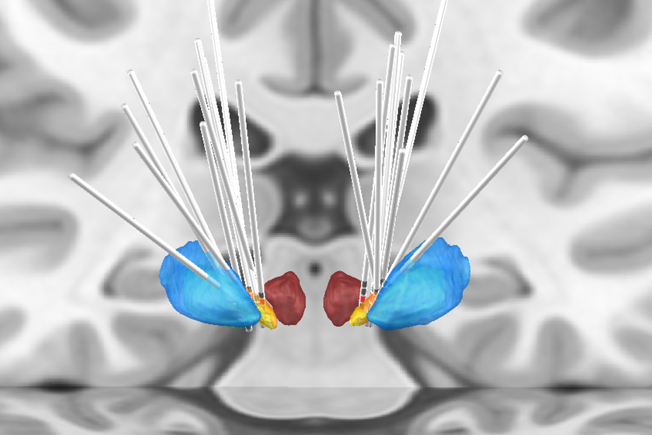
Method: 15 medicated PD patients with MR-approved neurostimulators were scanned at a 1.5 Tesla magnet twice (DBS ON, DBS OFF), as well as 19 matched controls. BOLD fMRI images were acquired while the participants viewed images showing food stimuli (sweet food, salty food, neutral). Following a whole brain analysis, the CONN Toolbox was used to identify changes in functional connectivity (FC) of pre-defined brain networks by a seed-based correlation analysis. Further, DBS electrodes were localized using Lead DBS software and volumes of tissue activated (VTA) were calculated.
Results: Whole brain GLM revealed a main effect of DBS in lingual gyrus (LiG), cuneus, middle cingulate and central operculum (cluster level, uncorrected, p≤0.001). An interaction was found for food images during active DBS in left LiG and superior parietal lobe bilaterally (FWE,p≤0.001). In line, FC analysis revealed significant alterations in the salience network (p≤0.05, FDR-corr.): while DBS OFF was associated with a negative correlation between insula and right supramarginal gyrus (SMG), DBS increased FC between insula and SMG for food vs. non-food and sweet food vs. neutral images (p≤0.05,FDR-corr.). Furthermore, patients with higher VTAs of the associative but not the sensorimotor STN showed a trend towards lower postoperative weight gain (R=-0.41, p=0.08, n=13).
Conclusion: DBS globally increased attentional control and may thus bias the brain towards an increased awareness of visual food stimuli. Our findings provide new evidence for state-dependent abnormalities demonstrating impaired salience processing and resulting alterations that could potentially lead to aberrant top-down deficiencies driving alterations in eating behavior and consequently weight gain.
To cite this abstract in AMA style:
J. Steinhardt, H. Hanßen, M. Heldmann, A. Neumann, J. Voges, J. Krauss, V. Tronnier, T. Münte, N. Brüggemann. Increased attention for food stimuli as a mechanism for weight gain in patients with Parkinson’s disease undergoing DBS of the subthalamic nucleus [abstract]. Mov Disord. 2020; 35 (suppl 1). https://www.mdsabstracts.org/abstract/increased-attention-for-food-stimuli-as-a-mechanism-for-weight-gain-in-patients-with-parkinsons-disease-undergoing-dbs-of-the-subthalamic-nucleus/. Accessed October 4, 2026.« Back to MDS Virtual Congress 2020
MDS Abstracts - https://www.mdsabstracts.org/abstract/increased-attention-for-food-stimuli-as-a-mechanism-for-weight-gain-in-patients-with-parkinsons-disease-undergoing-dbs-of-the-subthalamic-nucleus/