
Category: Genetics (Non-PD)
Objective: Genomic discovery often occurs in large institutions, but the contribution of small, rural genetics clinics must not be overlooked. While rare, these rural genetics clinics often work with underserved or special populations and can build a strong genomic discovery program with specific tools.
Background: The innovative use of diagnostic tools has enabled rural geneticists at non-profit clinics to contribute to genomic discovery in the Old Order Amish and Mennonite (Plain) populations of Northern America. The Plain people are descended from Swiss Anabaptists immigrants who fled violent religious persecution in the early 18thcentury and came to the New World. Population bottleneck, founder effect, and genetic drift compounded by consanguinity and large family size have led to high prevalence of rare genetic disorders including a variety of movement disorders affecting children and adults.
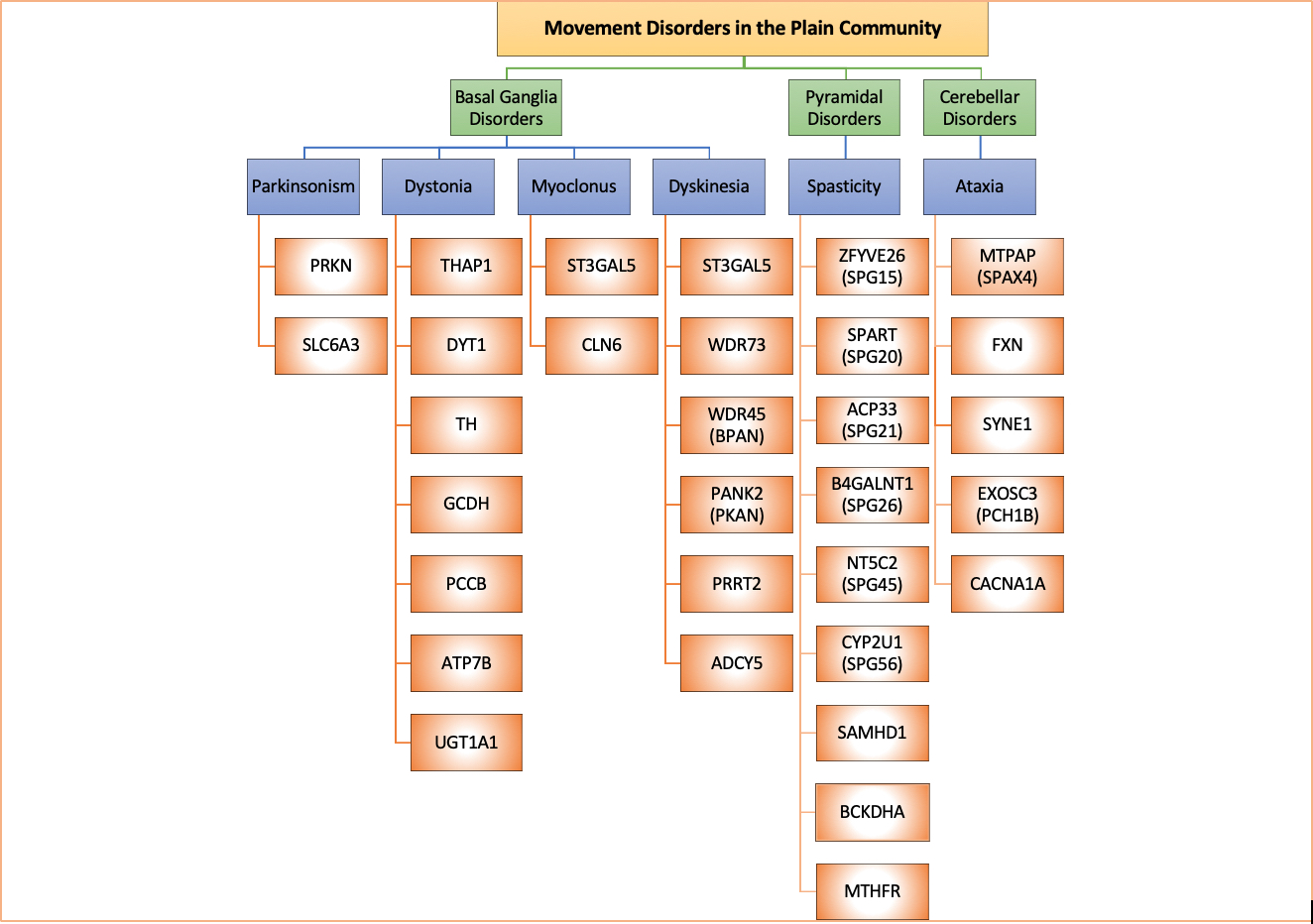
Method: There are 30-40 different movements disorders seen by clinicians taking care of children and adults with special health care needs in the Plain populations. There is considerable overlap among these disorders with regard to their clinical presentation. However, they can be roughly classified according to those that predominantly affect the cerebellum and present with ataxia, the basal ganglia presenting with Parkinsonism, dystonia, myoclonus, or dyskinesia, and the pyramidal system presenting predominantly with spasticity (Figure 1).
Results: The accumulation of genetic knowledge over time allows rural health clinics focused on the needs of the Plain community to create efficient and affordable diagnostic tools. For example, all of the specific monogenic causes of motor disability cited above have been consolidated onto a single next-generation sequencing chip which can be used for rapid, parsimonious diagnostic testing of probands with spastic, ataxic, or extrapyramidal disorders of movement. This same screening platform can be used to conduct population-specific carrier testing, allowing high-risk newborns to be diagnosed before the onset of symptoms and opening a critical window of opportunity for preventative therapies.
Conclusion: Because many pathogenic variants are highly enriched within the Plain communities, we have encountered comparatively large number of individuals with otherwise ultra-rare disorders. Thus, as new disease-modifying therapies emerge, the Plain communities are ideally positioned to demonstrate their clinical effectiveness.
To cite this abstract in AMA style:
Z. Ammous. Movement Disorders in the Plain People [abstract]. Mov Disord. 2020; 35 (suppl 1). https://www.mdsabstracts.org/abstract/movement-disorders-in-the-plain-people/. Accessed October 6, 2026.« Back to MDS Virtual Congress 2020
MDS Abstracts - https://www.mdsabstracts.org/abstract/movement-disorders-in-the-plain-people/